Modular construction is moving beyond repetitive hotel rooms and temporary site cabins. Today, factories can produce apartment walls, bathroom pods, and entire building sections while site teams prepare foundations. This shift raises a practical question: what are the latest trends in modular construction, and which ones can improve real project outcomes?
McKinsey’s 2019 report, Modular Construction: From Projects to Products, estimated that modular methods could reduce construction time by 20–50% and costs by up to 20%, when projects are designed and delivered effectively. These are potential gains, not guarantees. Jan Mischke, a McKinsey partner and report co-author, frames the opportunity as a shift “from projects to products”—a concise description of construction becoming more standardized and repeatable. The report also projected substantial market growth, while warning that companies must rethink design, supply chains, and production to capture it.
The trends now reshaping the sector include design for manufacture and assembly, building information modeling, digital twins, robotics, low-carbon materials, and hybrid systems combining modular and conventional construction. Procurement strategies are changing, too: teams increasingly coordinate factory production with transport, cranes, and site access. Details matter. A module that cannot pass through a road junction can erase schedule gains quickly.
Not every project benefits. Transport limits, early design commitments, and inconsistent standards remain real constraints. Some claims also outrun the evidence. This guide examines ten current trends, the data behind them, and where practical caution still belongs.
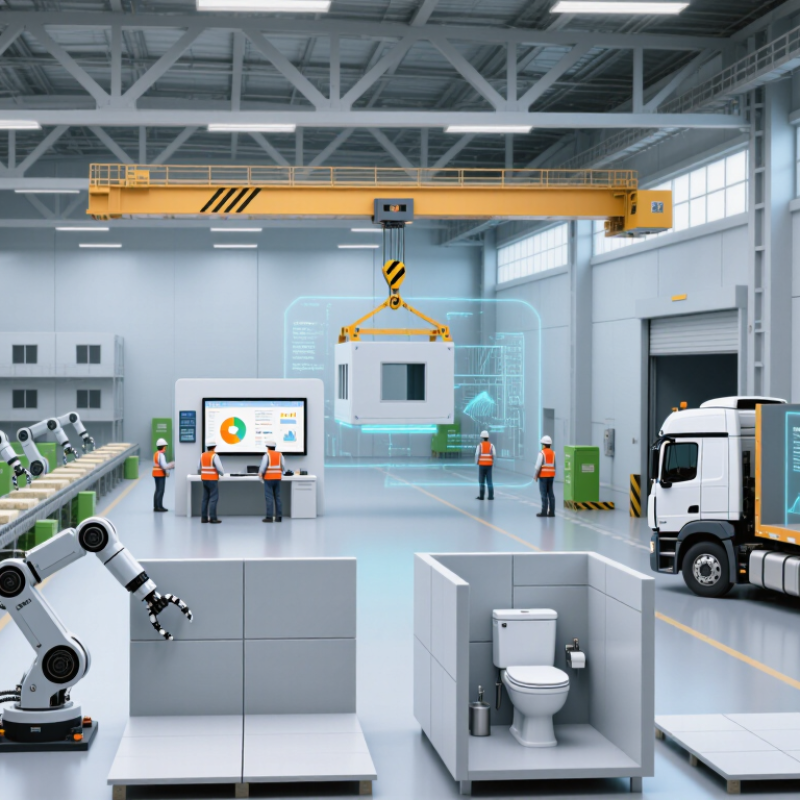
What Are the Top 10 Latest Trends in Modular Construction?
Factory Automation and Robotics: Modular Builds 20–50% Faster
Factory automation is changing how modular buildings are designed, assembled, and inspected. A 2019 industry analysis reported that modular construction can be 20–50% faster than conventional building methods. The advantage comes from controlled production, repeatable tasks, and fewer weather delays.
Inside a modern factory, robotic arms can cut panels, place fasteners, and move heavy frames. Sensors check measurements before units leave the production line. Workers still make critical decisions, especially when materials vary or designs change. This balance matters because construction sites rarely behave like perfect assembly lines.
The speed claim is useful, but it is not magic. Poor planning can create expensive bottlenecks. A delayed component may stop an entire module from moving forward. Experienced teams reduce this risk through digital coordination, early quality checks, and clear delivery schedules. Small errors become visible sooner, which can prevent larger site problems.
There is also a human concern. Automation may reduce repetitive lifting, yet it requires better technical training. Some factories are not ready for that transition. They may invest in machines before improving workflows. That order can weaken productivity rather than improve it. Careful measurement remains essential, including tracking rework, transport time, safety incidents, and installation delays. Speed should support quality, not replace it.
What Are the Top 10 Latest Trends in Modular Construction?
Modular construction is moving from factory efficiency toward connected decision-making. Building information modeling now links design files, procurement schedules, and installation records. Artificial intelligence can flag clashes before steel frames reach the site. Digital twins add another layer by showing how a building may perform after handover.
A widely cited industry study estimated that poor data created $1.85 trillion in construction costs during 2020. The figure exposes a practical weakness: disconnected spreadsheets can delay even a well-designed project. A missing revision may send the wrong window size to a factory. That gap matters. Reliable teams now use common data environments, structured naming, and permission controls. Sensors can track module temperature, movement, and storage time. Predictive systems may also improve delivery routes and reduce idle cranes.
The workflow is not flawless. AI can repeat bias from incomplete records, while digital twins become unreliable when workers skip updates. Human review remains essential. Site managers still need to compare a model with a physical connection, a tolerance mark, or a damp corner. Small errors accumulate quickly. Modular firms are also testing robotic assembly, low-carbon materials, automated quality checks, and reusable component libraries. These trends promise speed, but their value depends on disciplined data capture at every stage. Progress can look impressive on a screen. The building still has to fit.
BIM, AI, and digital twins are helping move construction toward a more connected, data-driven future.
What this means: The market estimate points to continued growth in modular construction. Trends such as BIM, AI-assisted planning, digital twins, design for manufacture and assembly, and automated fabrication can support more coordinated project delivery. Industry research also estimated that poor data cost the construction sector $1.85 trillion in 2020, underscoring the value of reliable, connected project information.
Source note: Published global modular-construction market estimate; 2027 figure is a forecast, not an observed result.
Hybrid construction combines panelized assemblies with volumetric modules. It offers flexibility without losing factory efficiency. Wall panels can create varied room layouts, while volumetric units deliver bathrooms, kitchens, or utility cores. This balance supports customized housing, hotels, schools, and healthcare facilities. It also reduces repeated site work, material waste, and weather-related delays.
The strongest results come from early coordination. Designers, manufacturers, engineers, and site crews must agree on connection details before production begins. A digital model can identify clashes between panels, modules, plumbing, and electrical routes.
Physical mock-ups remain valuable. A two-millimeter tolerance problem can delay an entire floor. That detail is easy to underestimate.
Hybrid systems are not automatically cheaper or faster. Transport limits, crane access, local codes, and factory capacity can change the outcome. Some projects still require too many custom parts, weakening the benefits of standardization.
Tips:
Define the module-panel interface early. Check lifting points and delivery routes before final design approval. Keep service zones accessible for future repairs. Test one complete junction, including insulation, fire protection, and finishes. Review the prototype honestly. It may expose an attractive idea that is difficult to build.
Low-carbon materials are reshaping modular construction. Buildings and construction produced 37% of global CO₂ emissions in 2022, according to UNEP. That figure gives off-site manufacturing a serious responsibility. Modular factories can measure material use more consistently. They can also reduce cutting waste, transport trips, and rework.
The numbers are stark.
Recent projects increasingly combine recycled steel, lower-carbon concrete, engineered timber, and bio-based insulation. Recycled steel can reduce demand for virgin resources when local supply is reliable. Lower-carbon concrete may use supplementary materials instead of part of its cement content. Engineered timber stores biogenic carbon, but responsible forestry and fire safety remain essential. Materials must fit the climate, not only the marketing language.
Design for disassembly is another important trend. Bolted connections can make modules easier to repair, relocate, or reuse. Digital material passports may record component origins, quantities, and future recovery options. Factory energy monitoring can reveal where electricity use remains excessive. This is useful, but not perfect. A factory powered by fossil fuels may weaken the environmental advantage of modular production. Long-distance delivery can create another hidden burden. Project teams should compare whole-life emissions, including manufacturing, transport, installation, maintenance, and eventual reuse. Independent life-cycle assessments and transparent environmental product declarations improve reliability. Still, data quality varies, and early estimates often change when suppliers provide detailed information.
Circular modules are gaining attention as builders confront the scale of construction waste. The U.S. generated about 600 million tons of construction and demolition debris in 2018, according to the Environmental Protection Agency. Much of that material came from demolition, not new construction alone. Still, the figure makes waste hard to ignore.
Modular construction can support circular design when components are planned for repair, reuse, or recycling. A wall panel with accessible fasteners is easier to remove than one sealed behind layers of adhesives. Standardized dimensions can also help modules fit new layouts instead of going straight to disposal. Small design choices matter.
But modular does not automatically mean circular. Transport damage, incompatible materials, and weak take-back systems can undermine the benefits. A steel frame may be reusable, while bonded finishes attached to it may not be. That gap deserves more attention.
Project teams can start by recording material quantities, documenting connections, and specifying parts that can be separated with ordinary tools. They should also plan where recovered modules will go before construction begins. That takes coordination. It can feel slower at first, and not every salvaged component will find a second use. Yet measuring what is actually recovered—not just what was designed for reuse—gives the industry a more honest picture of progress.
| Rank | Trend | Key Dimension | Verified Data Point | What It Means for Modular Construction | Source |
|---|---|---|---|---|---|
| 1 | Off-site volumetric construction | Schedule and production location | McKinsey reports that modular construction has the potential to speed project delivery by 20–50%; this is a potential range, not a guaranteed project outcome. | Move suitable building work into a factory while site preparation proceeds in parallel. | McKinsey, “Modular construction: From projects to products” |
| 2 | Repeatable, standardized modules | Design repeatability and cost | The same McKinsey analysis says a product-based approach could reduce costs by up to 20%; results depend on design, scale, and project conditions. | Use a consistent module platform and limit unnecessary one-off configurations while allowing project-specific finishes. | McKinsey, “Modular construction: From projects to products” |
| 3 | Circular modules and material recovery | Waste prevention, reuse, and recycling | The U.S. generated about 600 million tons of construction and demolition debris in 2018. EPA notes that this is more than twice the amount of municipal solid waste generated that year. | Design modules for repair, component recovery, and material separation to help reduce demolition and disposal waste. | U.S. EPA, Construction and Demolition Debris |
| 4 | Design for disassembly and reuse | Connections and end-of-life planning | EPA’s 2018 estimate covers construction and demolition debris, underscoring the scale of material flows that recovery-oriented design can address. | Favor accessible, reversible connections and document component specifications so modules and parts can be adapted or reused. | U.S. EPA, Construction and Demolition Debris |
| 5 | Lower-carbon material selection | Embodied carbon and material specifications | The International Energy Agency identifies cement production as responsible for around 7% of global energy-system CO₂ emissions. | Compare material options using environmental product declarations and project-specific life-cycle assessment; prioritize lower-emission concrete and other suitable materials. | International Energy Agency, Cement |
| 6 | High-performance modular envelopes | Operational energy and airtightness | Buildings account for about 30% of global final energy consumption, according to the IEA. | Coordinate insulation, airtightness, thermal bridges, and window details in factory production, then verify performance during site installation. | International Energy Agency, Buildings |
| 7 | Mass-timber and hybrid systems | Structural system and building height | The 2021 International Building Code includes Type IV-A provisions for qualifying mass-timber buildings up to 18 stories, subject to code requirements. | Combine timber modules or panels with other structural materials where engineering, fire protection, and local code requirements allow. | International Building Code, 2021 edition |
| 8 | BIM-linked design for manufacture and assembly | Information coordination and fabrication data | ISO 19650-1:2018 sets out concepts and principles for information management across the life cycle of built assets using building information modelling. | Connect coordinated building models with fabrication, logistics, and installation information before components enter production. | ISO 19650-1:2018 |
| 9 | Factory automation and quality control | Repeatable production and inspection | Factory production makes it possible to use controlled work sequences and repeatable inspection checkpoints; performance gains vary by facility and product. | Apply automation selectively to repetitive tasks and use documented checks for dimensions, connections, moisture, and finishes. | McKinsey, “Modular construction: From projects to products” |
| 10 | Digital handover and lifecycle tracking | Asset information and future maintenance | ISO 19650-1:2018 frames information management across the asset life cycle, not only the design and construction stages. | Deliver consistent records for installed modules, components, maintenance needs, and future refurbishment or recovery. | ISO 19650-1:2018 |
Figures are reported with their original scope and caveats. Potential cost or schedule benefits are not guaranteed and depend on project conditions.
BIM connects design files, procurement schedules, and installation records. A missing revision can send the wrong window size to a factory. Human checks remain necessary.
AI can flag design clashes before steel frames reach the site. It may also predict delivery routes and reduce idle crane time. Incomplete records can create biased results.
Digital twins can show how a building may perform over time. Sensors may track temperature, movement, and storage duration. Skipped updates make the model unreliable.
One industry estimate linked poor data to $1.85 trillion in 2020 costs. Disconnected spreadsheets can delay production and installation. The exact figure may change.
Projects may use recycled steel, lower-carbon concrete, engineered timber, and bio-based insulation. Each material needs local supply, safety checks, and climate testing. Marketing claims are not enough.
No. Factory energy, long-distance delivery, and maintenance can increase total emissions. Teams should assess manufacturing, transport, installation, and reuse. The result may surprise them.
Designers can use accessible fasteners, standard dimensions, and separable materials. A bolted wall panel is easier to repair or relocate. Circular design is not automatic.
Transport damage, bonded finishes, and weak take-back systems can block reuse. Teams should record quantities and plan destinations before construction. Some recovered parts will still have no second use.
The latest developments in modular construction are reshaping how buildings are designed, manufactured, and assembled. Factory automation and robotics can help make projects 20–50% faster, while building information modeling, artificial intelligence, and digital twins improve coordination and reduce costly mistakes caused by poor data. Together, these tools support more predictable schedules and better control over materials and quality.
For readers asking what are the latest trends in modular construction, hybrid and customizable systems are another key answer: panelized and volumetric methods can be combined to suit different designs and site needs. The industry is also moving toward lower-carbon materials, reflecting the significant emissions associated with buildings and construction. Finally, circular modules designed for reuse, repair, and recycling offer a way to reduce construction debris and make better use of resources throughout a building’s life cycle.

Shupshy Container